
Cleveland & Dayton, Ohio — For a group of kindergarten and first-grade girls, science this year was not an abstract concept found in a textbook. It was something they built, launched, questioned, and proudly carried home.
The inaugural Girls of Tomorrow cohort, led by Parallax Advanced Research and the Ohio Aerospace Institute (OAI), brought together partners from the Ohio Space Grant Consortium (OSGC), Catalyzed Impact, Wright State University, Copeland, and Daily Dose of Reading, alongside educators, engineers and nonprofit leaders, to introduce young students to foundational STEM concepts through hands-on learning and mentorship. What emerged was not only a successful pilot program, but also a blueprint for how early exposure can shape confidence and curiosity long before career paths are chosen.
“I think it’s really critical to provide children with many opportunities to learn about science, starting at a young age,” said Dr. Mary Frame, director of cognitive research at Parallax/OAI. “Kids have an insatiable curiosity to understand how the world works, and the scientific method provides a means of discovering about the world.”
Watch: Ohio Tech Day 2025 | Inspiring the Next Generation of STEM Leaders — a look at how Parallax/OAI and partners are bringing hands-on STEM experiences and role models to girls across Ohio.
Building the Program Behind the Scenes
Lessons were modified to introduce basic concepts—such as what a microchip is or where chemicals appear in everyday life—before advancing into experiments and crafts. Volunteers also completed many activity steps ahead of time to accommodate short class windows and large groups of students, often adapting lessons in real time based on student engagement.
“A great deal of preparation happened behind the scenes,” said Erica Christoffers, a human factors researcher in Parallax/OAI’s Intelligent Systems Division. “But what often goes unseen is how much flexibility and quick thinking was required from the volunteer teachers during the program itself. We were constantly adjusting explanations, pacing, and activities to match the girls’ questions, energy and interests.”
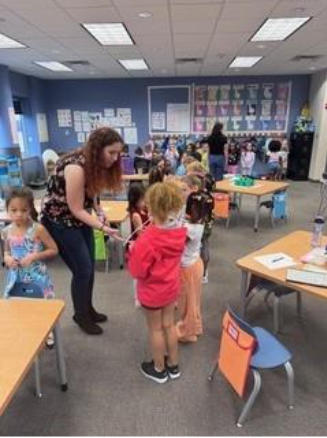
Caption: Frame assists cohort students with the STEM experiment.
The cohort relied on close collaboration among Parallax, OAI, and OSGC staff, school personnel, nonprofit partners, and industry volunteers. Organizing lesson materials alone required weeks of advance effort.
“The volunteers spent a great deal of time helping with organizing materials, especially Erica Christoffers, who spearheaded putting together each group’s activity materials and books at the start of the cohort,” Frame said. “She made the process so much easier for the rest of us volunteers to be able to focus on the teaching, rather than purchasing and organizing supplies.”
“Communication with the other volunteers was critical to program success,” René Meadors, process navigation lead at Parallax/OAI, said. “We would share how our session went, what changes we would make, and even combined classes a couple of times, which required additional prep work.”
“That collaboration showed up in the way each session felt cohesive and intentional,” said Christoffers. “Everyone brought different expertise—technical knowledge, educational experience, mentorship or organizational support—and those strengths complemented one another. It created an environment where the girls could learn from a variety of voices while still feeling supported and guided.”
Moments That Matter
For volunteers, the impact of the program often became clearest in moments of challenge rather than ease.
“There was one week where we were making paper rockets and one of the girls was in tears because something wasn’t working,” said Natalie Reed, a senior specialty engineer at Copeland. “By the end of the lesson she was beaming about her rocket and so proud of what she had created. To me, this is why these programs matter.”
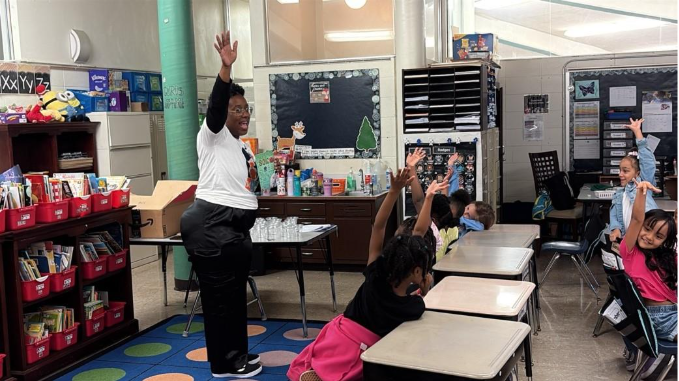
Caption: Myca Cater-Sims with Daily Dose of Reading reads to the cohort students.
Meadors saw that same impact reflected in the girls’ growing confidence.
“The girls were engaged, asking questions, and sharing examples of how they see science in their everyday life,” Meadors said. “That curiosity is what tells you the program is working.”
As the weeks progressed, volunteers noticed a shift in how students engaged with the material.
“During weeks 11 and 12, we noticed they were much more curious,” Frame said. “They asked relevant questions like, ‘How does the shuttle get back to Earth?’ and ‘How do the astronauts not burn up when it goes so fast?’ I welcome these kinds of questions since they show lesson-relevant curiosity.”
For Christoffers, those moments began on day one.
“Watching the girls walk into the classroom full of energy and excitement and then seeing their eyes light up during hands-on experiments, really drove home the impact of the program,” Christoffers said. “Those moments—when they were fully engaged, eager to participate and genuinely curious—made it clear why creating these opportunities matters.”
Watch: From Classrooms to NASA: How Ohio Tech Day Empowers Girls in STEM Careers — see how Parallax Advanced Research, the Ohio Aerospace Institute and partners are connecting girls across Ohio with hands-on STEM experiences and women leaders in aerospace and technology.
Laying the Groundwork for the Future
Program leaders say the first cohort reinforced the idea that workforce development begins far earlier than traditionally planned.
“This cohort was not just a pilot program,” said Dr. Annemarie Grassi Amefia, nonprofit architect and principal at Catalyzed Impact and senior advisor to Parallax/OAI. “It was the foundation of a pipeline that begins with curiosity and confidence and can ultimately lead to meaningful participation in advanced technology fields.”
Grassi Amefia emphasized that much of the work happened before the first lesson began.
“That included aligning Parallax/OAI’s workforce vision with early childhood pedagogy, translating complex STEM concepts into developmentally appropriate experiences, coordinating schedules across partners, and securing early funding,” Grassi Amefia said. “That work is invisible to most people, but it’s what makes a program feel seamless and intentional.”
Frame said early exposure allows concepts to be reinforced over time.
“Early STEM exposure affords the opportunity to reinforce concepts over the course of a child’s education,” Frame said. “It’s easiest to learn something if you have the scaffolding already in place.”
“The girls may not have fully grasped all of the concepts we taught them,” Reed said, “but my hope is we set them up for a lot of ‘ah-hah’ moments in the future.”
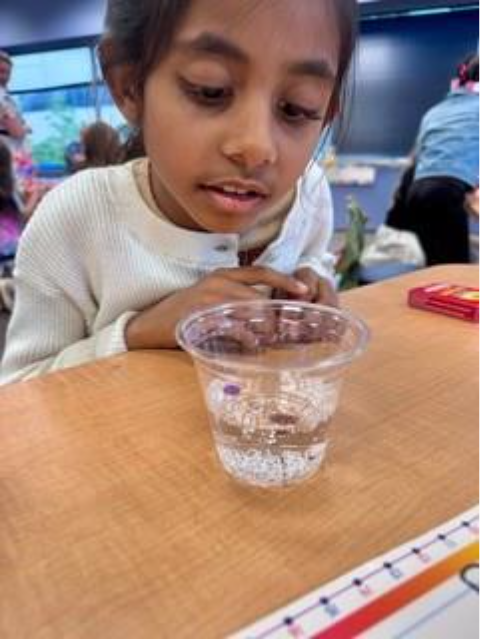
Caption: Girls of Tomorrow cohort student conducts a STEM experiment.
Planning is already underway for a second cohort, which will expand enrollment and introduce new curriculum elements informed by feedback from the pilot program.
For volunteers who gathered weekly—sometimes huddling in parking lots before class to refine lesson plans—the program’s success is measured less by metrics than by momentum.
“A moment that truly captured the spirit of the cohort happened toward the end of the program, when the girls were effortlessly recalling concepts from our very first sessions,” Christoffers said. “Hearing them connect ideas across weeks—and realizing how much they had retained—made it clear this program wasn’t just teaching STEM. It was building confidence, belonging and joy in learning.”
Frame echoed that sentiment.
“By having one person read while another set up activities, we could keep the girls consistently occupied,” Frame said. “It helped us go into class feeling prepared and in control.”
As Parallax/OAI continues to invest in workforce development and STEM education, the First Girls of Tomorrow cohort stands as an early proof point: when girls are given tools, encouragement and role models early, possibility becomes tangible.
###
About Parallax Advanced Research & the Ohio Aerospace Institute
Parallax Advanced Research is a research institute that tackles global challenges through strategic partnerships with government, industry, and academia. It accelerates innovation, addresses critical global issues, and develops groundbreaking ideas with its partners. In 2023, Parallax and the Ohio Aerospace Institute, an aerospace research institute located in Cleveland, OH, formed a collaborative affiliation to drive innovation and technological advancements across Ohio and the nation. The Ohio Aerospace Institute plays a pivotal role in advancing aerospace through collaboration, education, and workforce development.