

The EDGE Defense Summit in Pittsburgh highlighted the growing role regional ecosystems play in national security. Hosted by APEX and the Pittsburgh Technology Council (PTC) and moderated by Parallax Advanced Research, the event convened Department of the Air Force leadership, including AFRL, AFWERX, and the Air National Guard, alongside industry and academia to discuss acquisition reform, technology transfer and transition, and defense engagement.
The panel discussion was moderated by retired Army COL. Faith Chamberlain, SVP of Pittsburgh Operations and Advanced R&D Transitions at Parallax Advanced Research, who connected the region’s momentum to practical pathways for defense engagement. The conversation spanned acquisition reform, technology transfer and transition, and warfighter-driven collaboration—framing how industry and academia can move from capability to partnership and operational impact.
“As the acquisition landscape evolves, innovative ecosystems like Pittsburgh are demonstrating the value of close collaboration with operators and decision-makers”, says Chamberlain. “When industry and academia engage early, understand and align mission requirements, and plan for transition pathways from the outset, they shorten the distance between innovation and operational impact. One of our focuses at Parallax Advanced Research is facilitating these connections that translate mission needs into actionable partnerships. By guiding innovators through the technology transition process, we help remove barriers so promising capabilities reach the warfighter.”
PTC’s VP of Operations and Government Affairs, Brian Kennedy, opened by underscoring Pittsburgh’s defense footprint and growth, with PTC member companies expanding their defense business from roughly $500 million in 2020 to $18 billion in 2025, driven by national security needs and the region’s technical expertise in AI, autonomy, robotics, and advanced manufacturing.
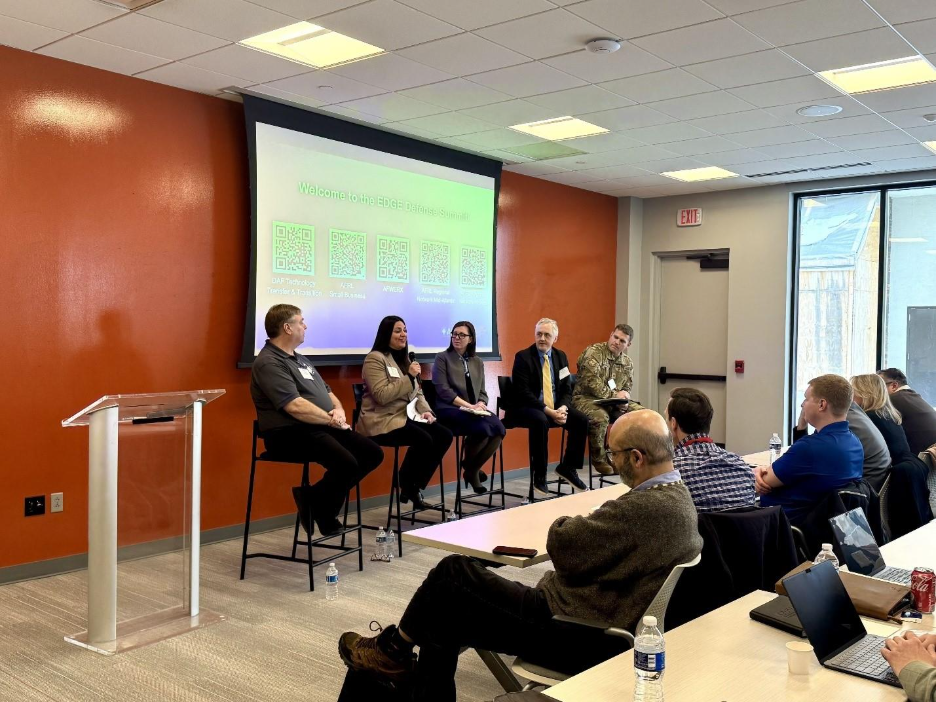
EDGE Defense Summit Panel, L to R: Allen Franke, Shanel Fultz, (ret) Col. Faith Chamberlain, Scott Aughenbaugh, Col. Jason Figley
Acquisition Reform and Faster Paths to Transition
A central theme of the panel was how organizations can adapt to ongoing defense acquisition reform. Shanel Fultz, Deputy Director of AFRL’s Small Business Office, highlighted AFRL’s internal restructuring to accelerate technology transition and better align with national security priorities. AFRL’s core mission remains research and development, but new enterprise-wide contract vehicles—such as the AFRL Multiple Award Contract (AMAC) IDIQ—reflect a shift toward more streamlined access points for industry and academia.
These efforts aim to reduce fragmentation, accelerate the development and transition of critical technologies, and lower the barrier for new entrants to engage with AFRL. Fultz noted that robotics, AI, and autonomy strongly align with AFRL priorities and encouraged industry to monitor opportunities posted through official government channels.
The Role of Partnership Intermediaries and Tech Transfer
Scott Aughenbaugh, Director of the DAF Tech Transfer and Transition (T3) Office, reinforced the importance of partnership intermediaries such as APEX in bridging government, academia, and industry—particularly when navigating mechanisms like CRADAs, OTAs, and other non-traditional agreements.
Aughenbaugh also highlighted recent efforts to expand access to government-developed intellectual property, including a patent evaluation initiative that allows industry to explore select defense patents through no-cost commercial evaluation licenses. These tech transfer agreements often serve as an effective on-ramp for pre-acquisition collaboration and have shown success in transitioning technologies to operational use.
SBIR and the Evolving Funding Landscape
AFWERX Outreach Lead Allen Franke addressed the status of SBIR/STTR and expectations following the program’s reauthorization. While funding is currently paused, Franke emphasized the importance of readiness across industry and academia, and aligning with the OUSW(R&E)’s six Critical Technology Areas will be key to future investment decisions.
AFRL continues to prioritize rapid funding of commercial technologies, with greater emphasis on transitioning existing solutions from prototype to operational use. Programs such as STRATFI and TACFI remain critical pathways for scaling promising technologies when supported by committed customers and matching funding.
Warfighter Collaboration and Operational Impact
Colonel Jason Figley, Maintenance Commander of the 171st Air Refueling Wing, shared a warfighter perspective on collaboration, emphasizing the importance of education, relationships, and exposure to emerging technologies. Direct engagement with academia and industry helps operational units identify solutions that improve readiness and sustainment.
The 171st highlighted collaboration with local small businesses and universities that strengthens mission readiness and supports workforce development across the ecosystem. Col. Figley noted these partnerships are critical to maintaining operational capability amid increasing demands.
Building Partnerships Through Direct Engagement
The summit featured curated 1-on-1 meetings connecting industry directly with DAF representatives, including AFRL, AFWERX, and operational units. The targeted conversations provided small businesses and new entrants with tailored guidance on alignment, partnership pathways, and engagement strategies.
Participants discussed technology applications, mission needs, and transition opportunities in a focused setting. These direct engagements can serve as a critical first step toward future collaboration, helping industry and academia better understand customer priorities while building relationships across the defense innovation ecosystem.
Takeaways for Industry and Academia
Across the event, the message was consistent: success in the defense market requires preparation. Industry and academia must understand how to identify the right opportunities, ensure their capabilities are visible, engage early through the right entry points, and build relationships across the ecosystem. For cities like Pittsburgh, the EDGE Defense Summit reinforced that local innovation paired with strong partnerships can directly support national security priorities.
To learn more about our innovation pathways and partnerships, visit: Strategic and Technology-Based Partnerships
###
About Parallax Advanced Research and the Ohio Aerospace Institute
Parallax Advanced Research is a research institute that tackles global challenges through strategic partnerships with government, industry, and academia. It accelerates innovation, addresses critical global issues, and develops groundbreaking ideas with its partners. With offices in Ohio and Virginia, Parallax aims to deliver new solutions and speed them to market. In 2023, Parallax and the Ohio Aerospace Institute formed a collaborative affiliation to drive innovation and technological advancements in Ohio and for the nation. The Ohio Aerospace Institute plays a pivotal role in advancing the aerospace industry in Ohio and the nation by fostering collaborations between universities, aerospace industries, and government organizations, and managing aerospace research, education, and workforce development projects.